The Pakistan Business Web Index 2026
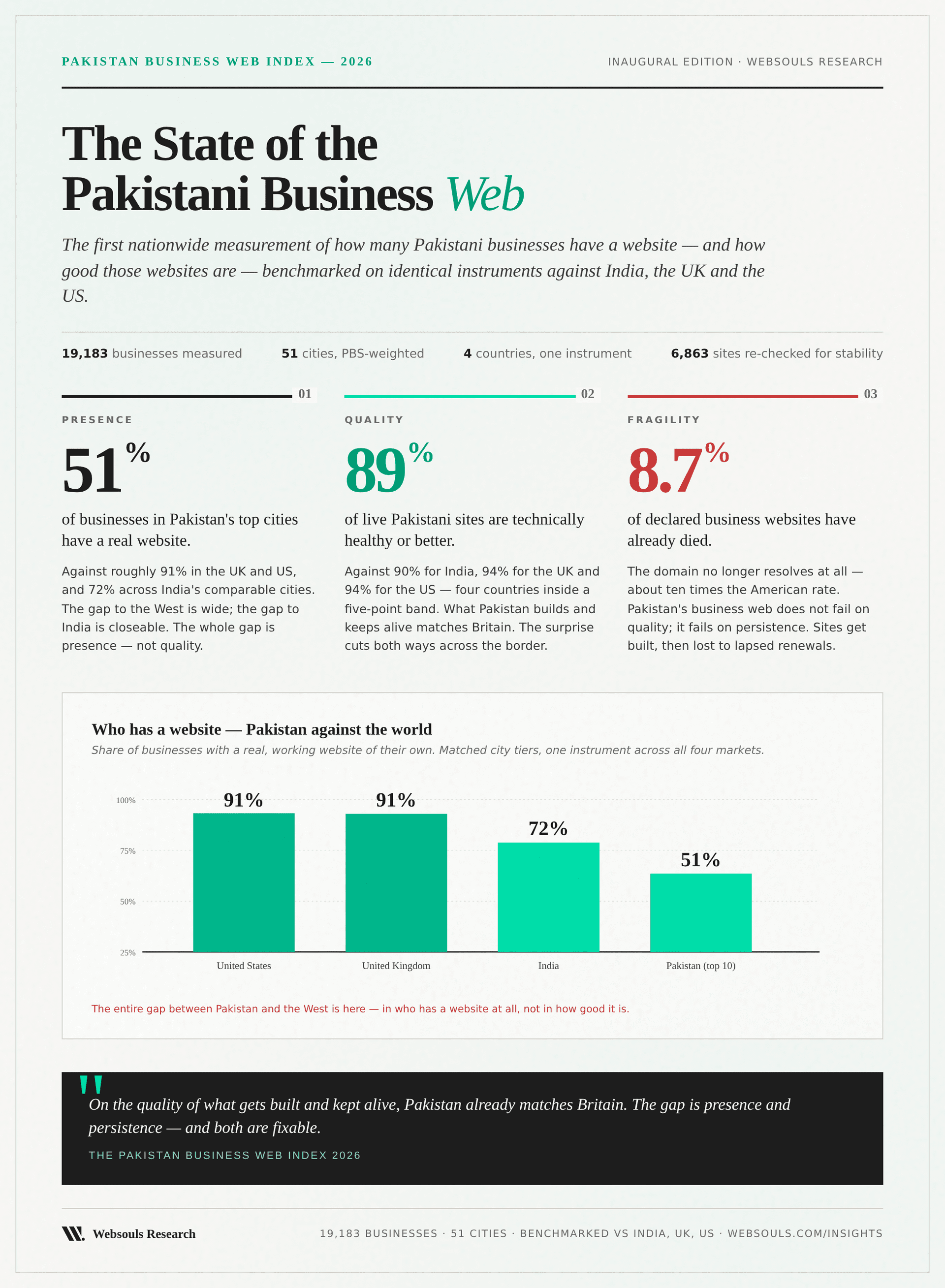
The first nationwide measurement of how many Pakistani businesses have a website — and how good those websites are — benchmarked against India, the UK and the US.
Why this study exists
Until now, nobody had measured the state of business websites in Pakistan. The big global technology surveys treat Pakistan as too small to report separately, and local discussion runs on opinion and anecdote. So the simplest questions had no real answers: how many Pakistani businesses actually have a website? Is what they build any good? And how far behind — or ahead — is the country really?
This study answers those questions with measurement rather than opinion. As far as we know, it is the first of its kind for Pakistan. We took a sample of 19,183 businesses across 51 cities and weighted it using the Pakistan Bureau of Statistics count of businesses by region, so the sample reflects the real spread of businesses across the country. We then measured businesses in India, the UK and the US using exactly the same tools, so the comparisons are fair.
1. Who has a website
Across the full national sample — 19,183 businesses in 51 cities, weighted to the PBS business count — 37.4% have declared a real website of their own. 57.5% have no web presence at all, and 5.1% rely only on a social-media page. Behind that single national figure lie two strong patterns: the size of the city, and how established the business is.
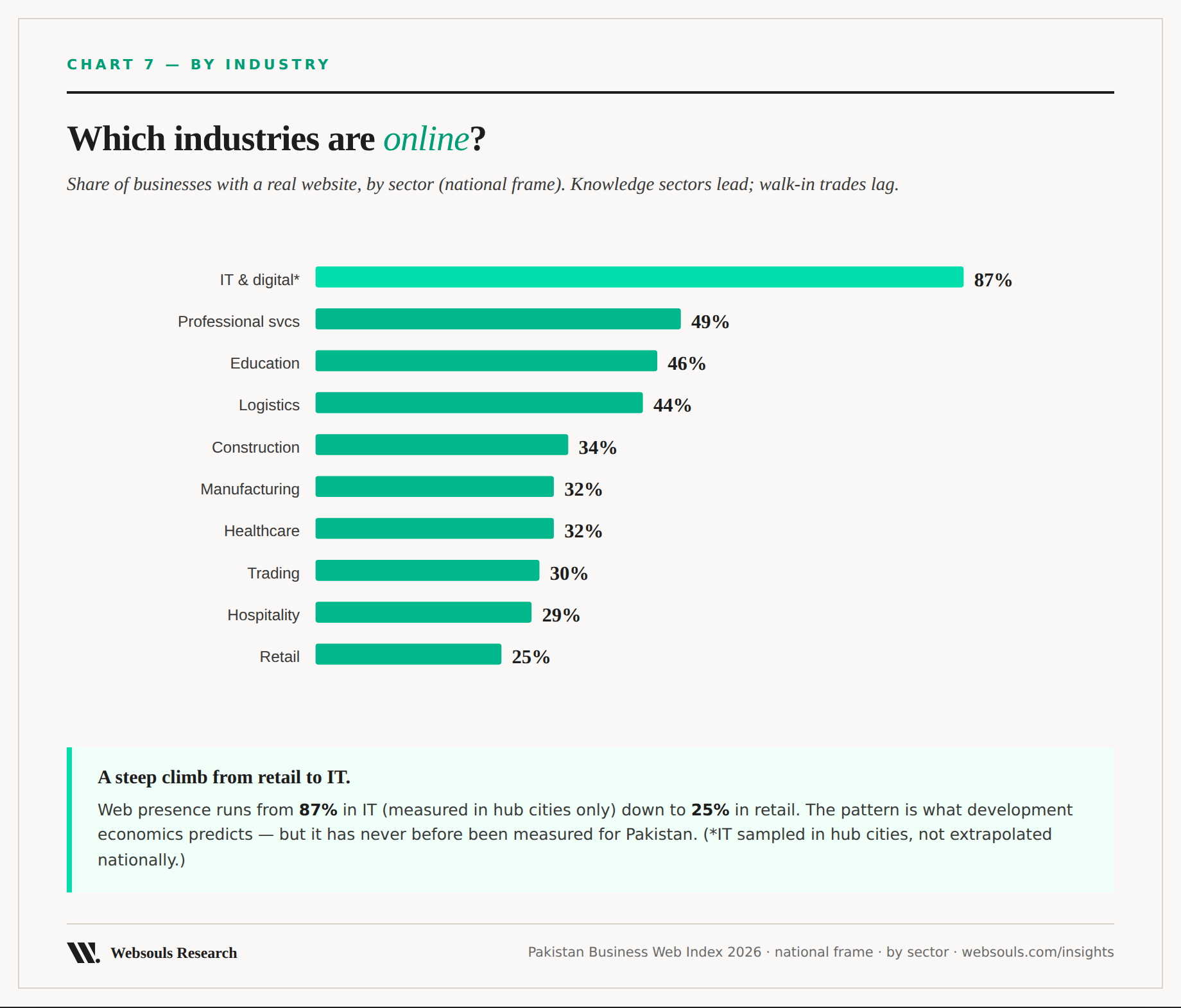
By industry. Web presence runs from 87% in IT and digital services (in the hub cities where they cluster) down through professional services 49%, education 46%, logistics 44%, construction 34%, manufacturing 32%, healthcare 32%, trading 30%, hospitality 29% and retail 25%.
By business maturity. The more established a business, the more likely it is to have a website — from 21% among businesses with very few Google reviews, up to 58% for those with 200 or more.
2. The city league table
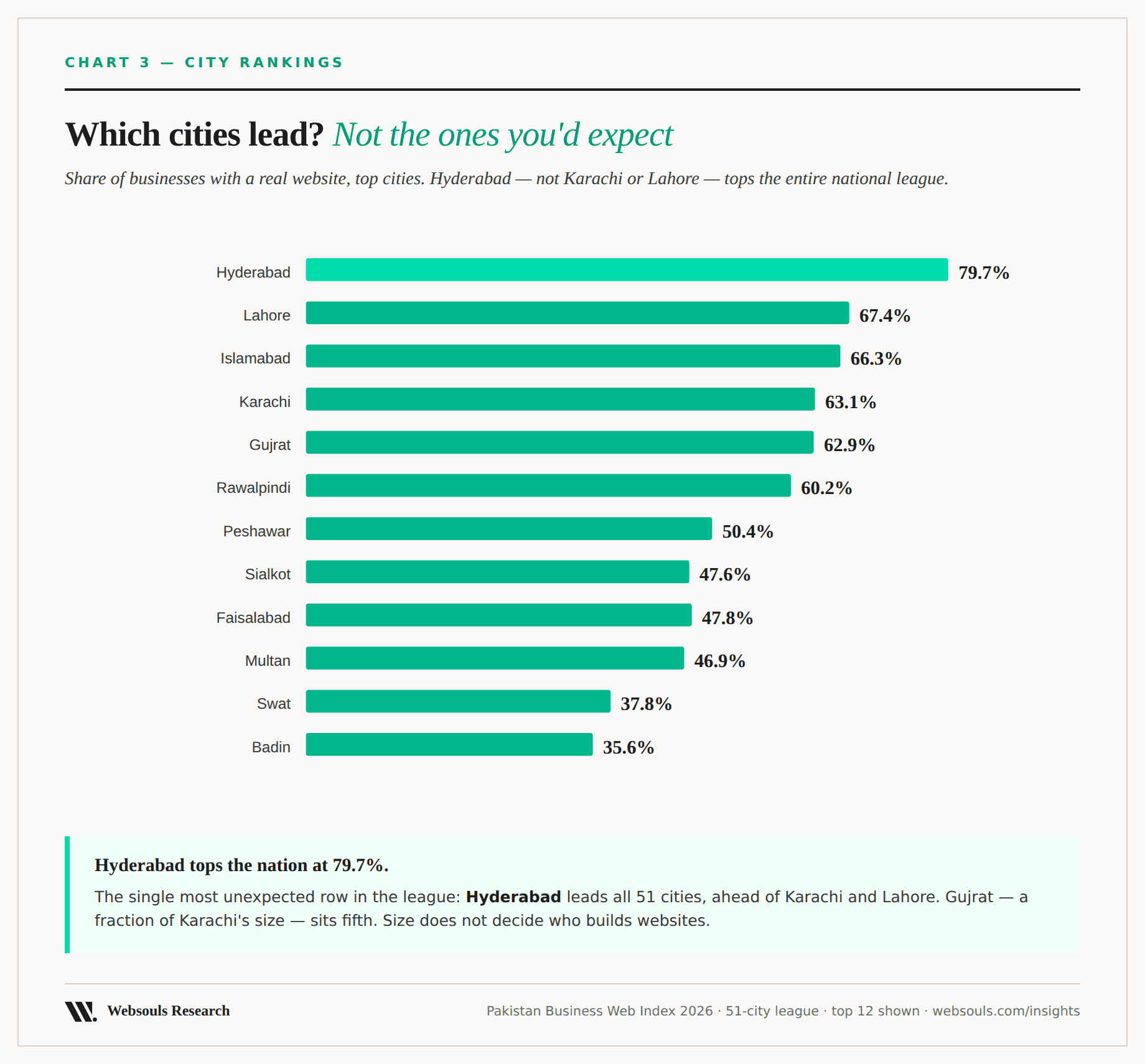
All 51 cities were ranked by the share of their businesses that have a website. Among the big cities it is Lahore, not Karachi, where the largest share of businesses have a website — Lahore 67%, Karachi 63%, Rawalpindi 60%. The standout is Gujrat at 63%: a city a fraction of Karachi's size, out-performing almost everywhere.
The highest figure anywhere in the table belongs to Hyderabad, at 79.7%. We publish it, but we do not lead on it. It rests on 256 businesses, against 1,364 in Lahore and 1,692 in Karachi, and a smaller sample can produce a higher number. Whether Hyderabad genuinely leads the country is a question for the second edition to answer, not a claim this one will make.
The most telling comparison for a Pakistani reader is each industrial city against its direct Indian equivalent: Sialkot 47% against Jalandhar 64%, Faisalabad 47% against Ludhiana 63%, Gujranwala 39% against Rajkot 68%. Same industries, same scale — and a closeable gap.
3. Websites that have died
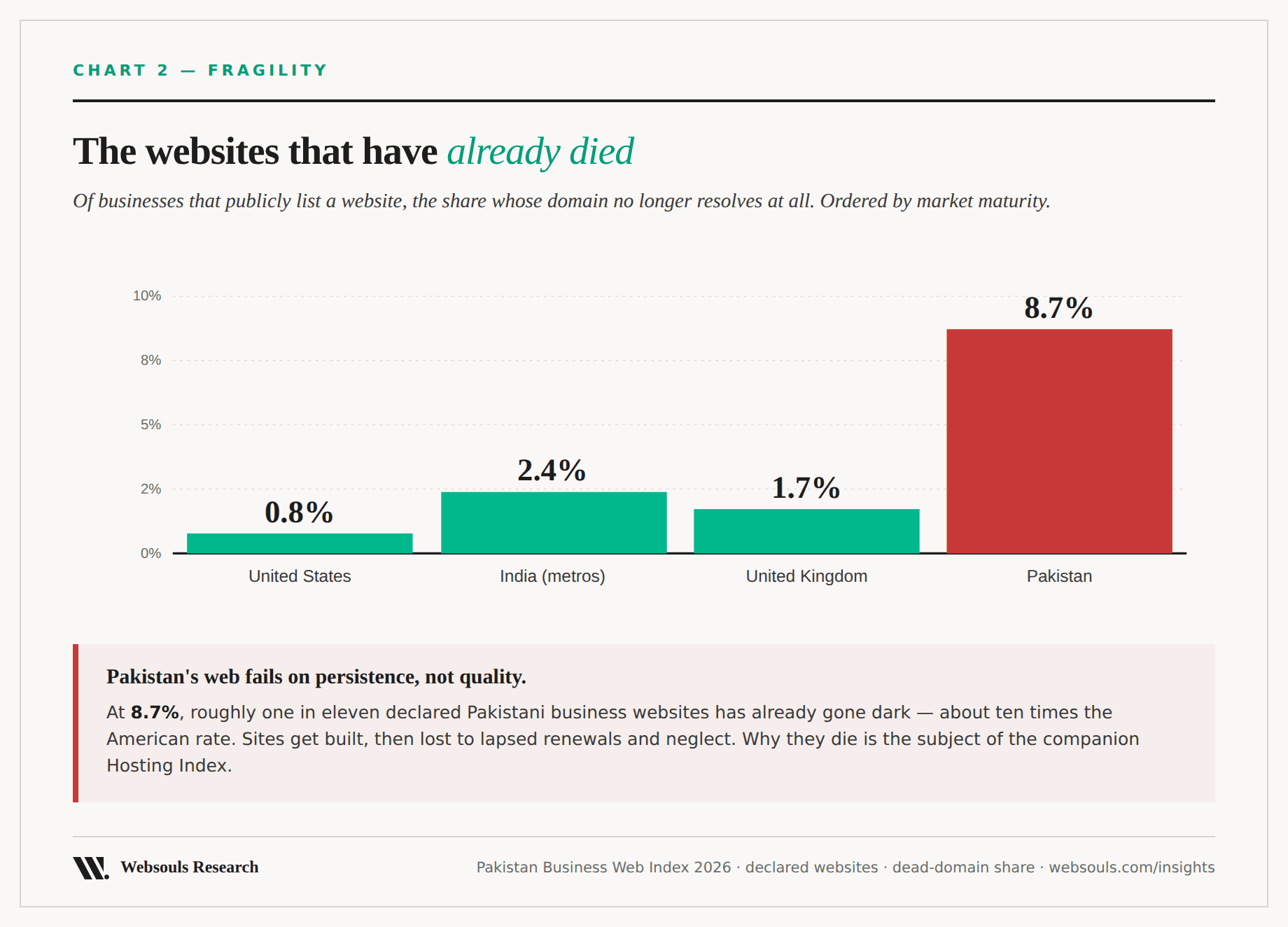
8.7% of Pakistani businesses that list a website have already lost it — the site no longer loads at all. That is roughly ten times the American rate and twice the rate in India's major cities. This is where Pakistan's business web really loses ground: not in the quality of what gets built, but in how quickly it dies — sites are created, then lost to unpaid renewals, lapsed hosting and neglect.
4. What the web is built with
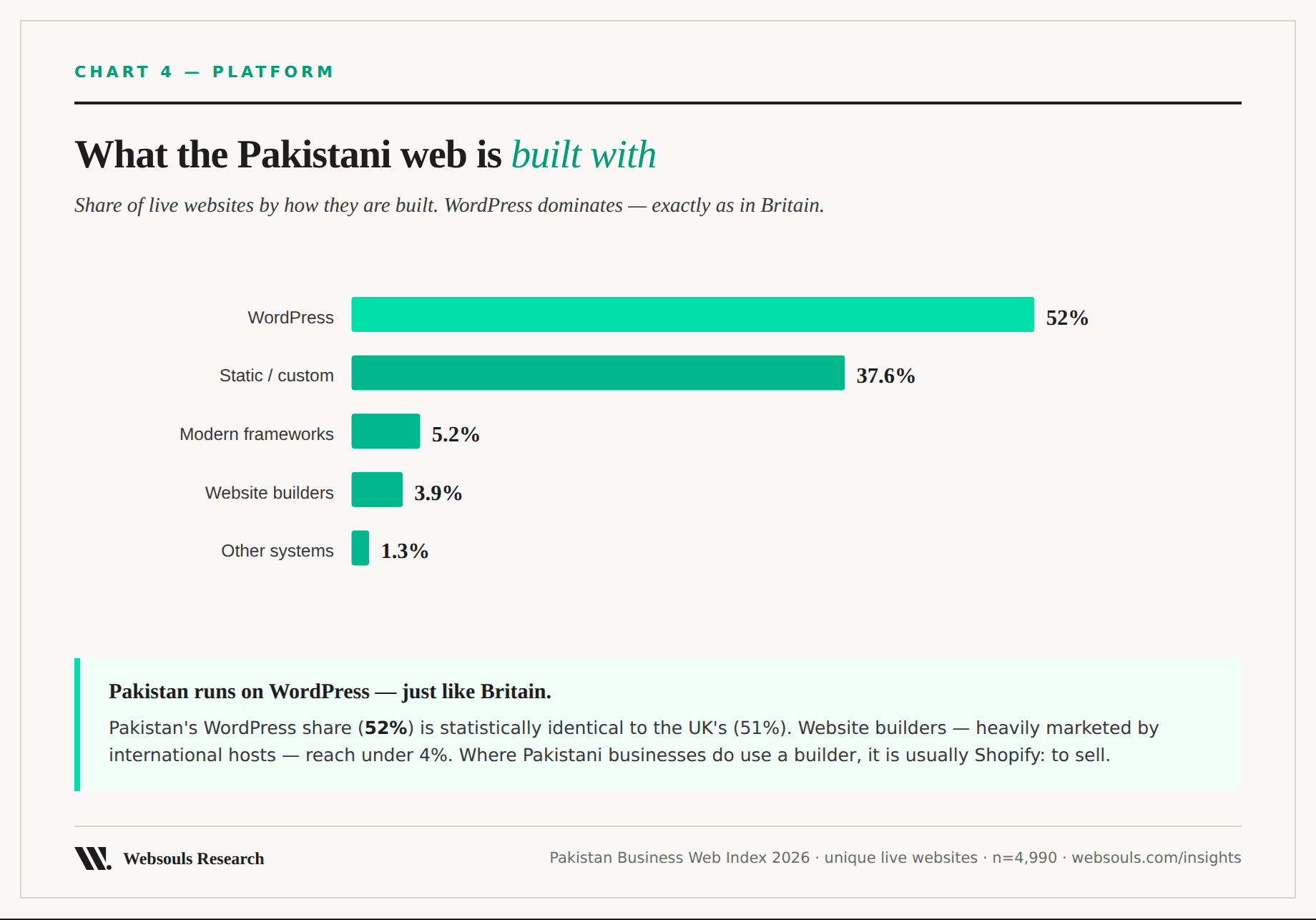
Among live websites, Pakistan's web runs mostly on WordPress — about 52% — and here is the sentence few would have predicted: that is statistically identical to Britain's 51%. The real outlier is India, which builds more custom-made sites. Website builders — heavily marketed by international hosts — reach under 4% in Pakistan.
5. Technical health — the surprising convergence
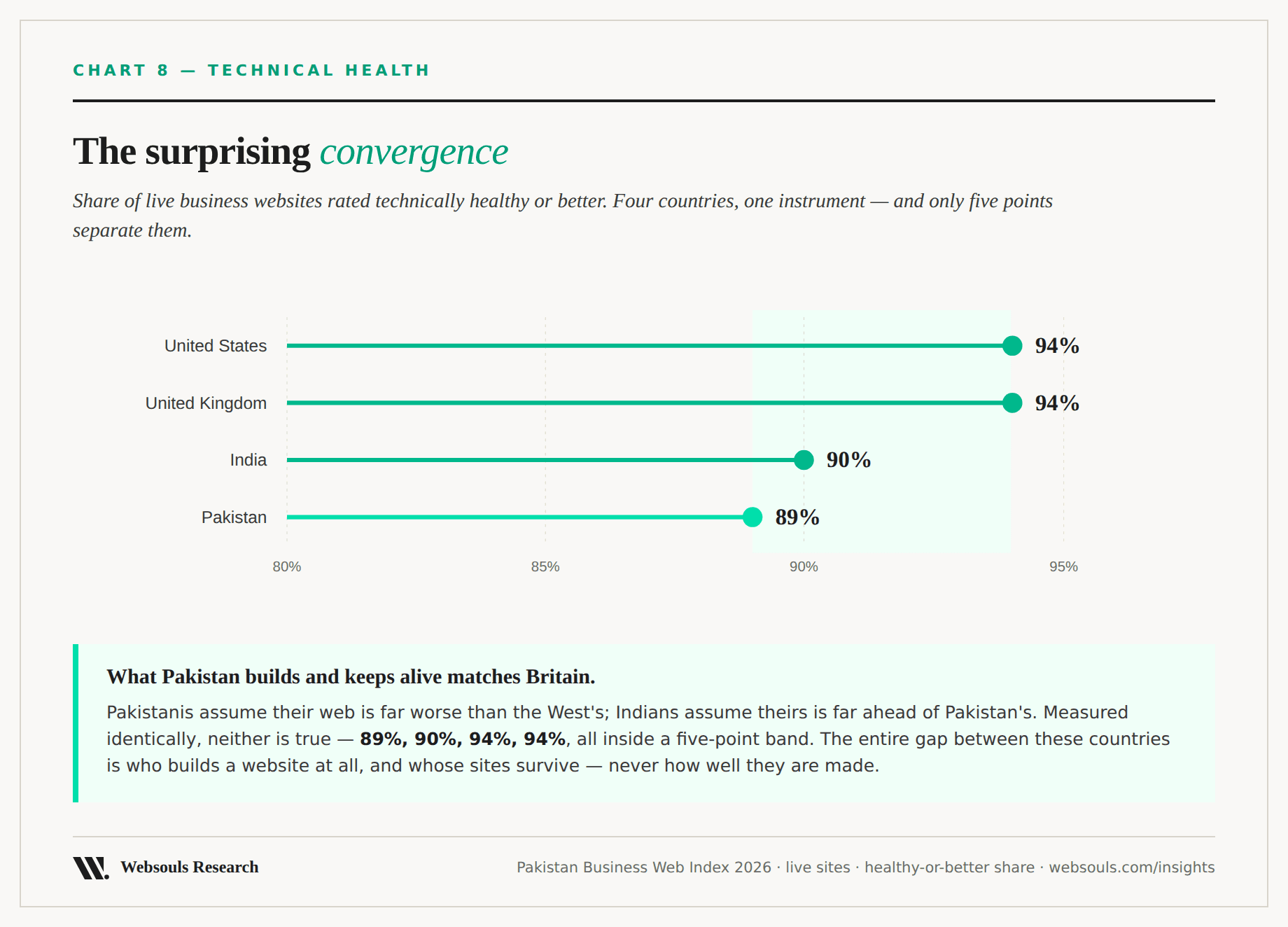
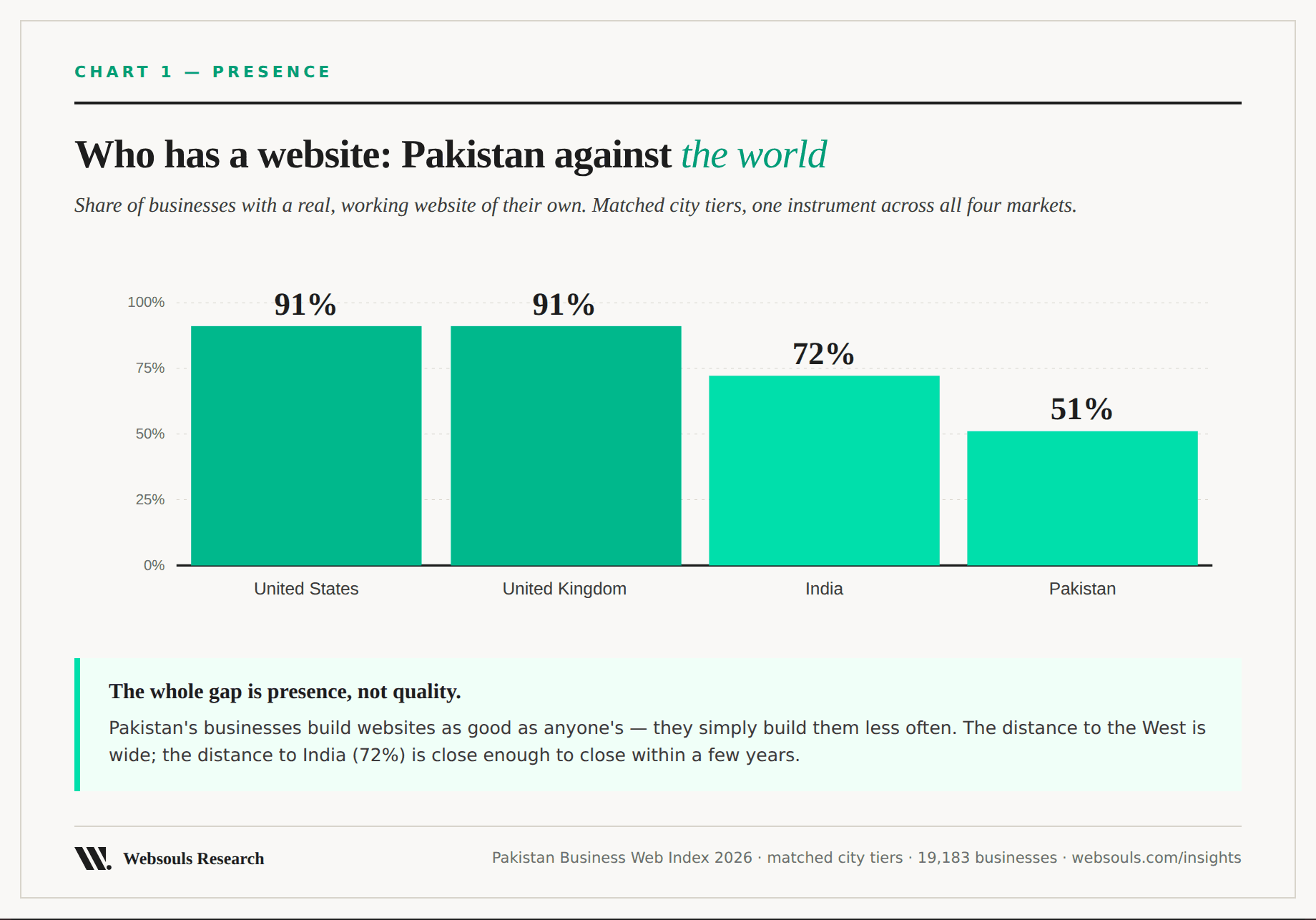
Measured on identical tools, the live Pakistani business web is in materially the same technical shape as Britain's, America's and India's: 89% healthy or better, against 90% for India and 94% for the UK and US. Four countries, one instrument, one five-point band. Pakistanis assume their web is far worse than the West's; Indians assume theirs is far better than Pakistan's. Measured properly, neither is true. The whole gap is who builds a website at all, and whose sites survive.
6. How businesses talk to customers
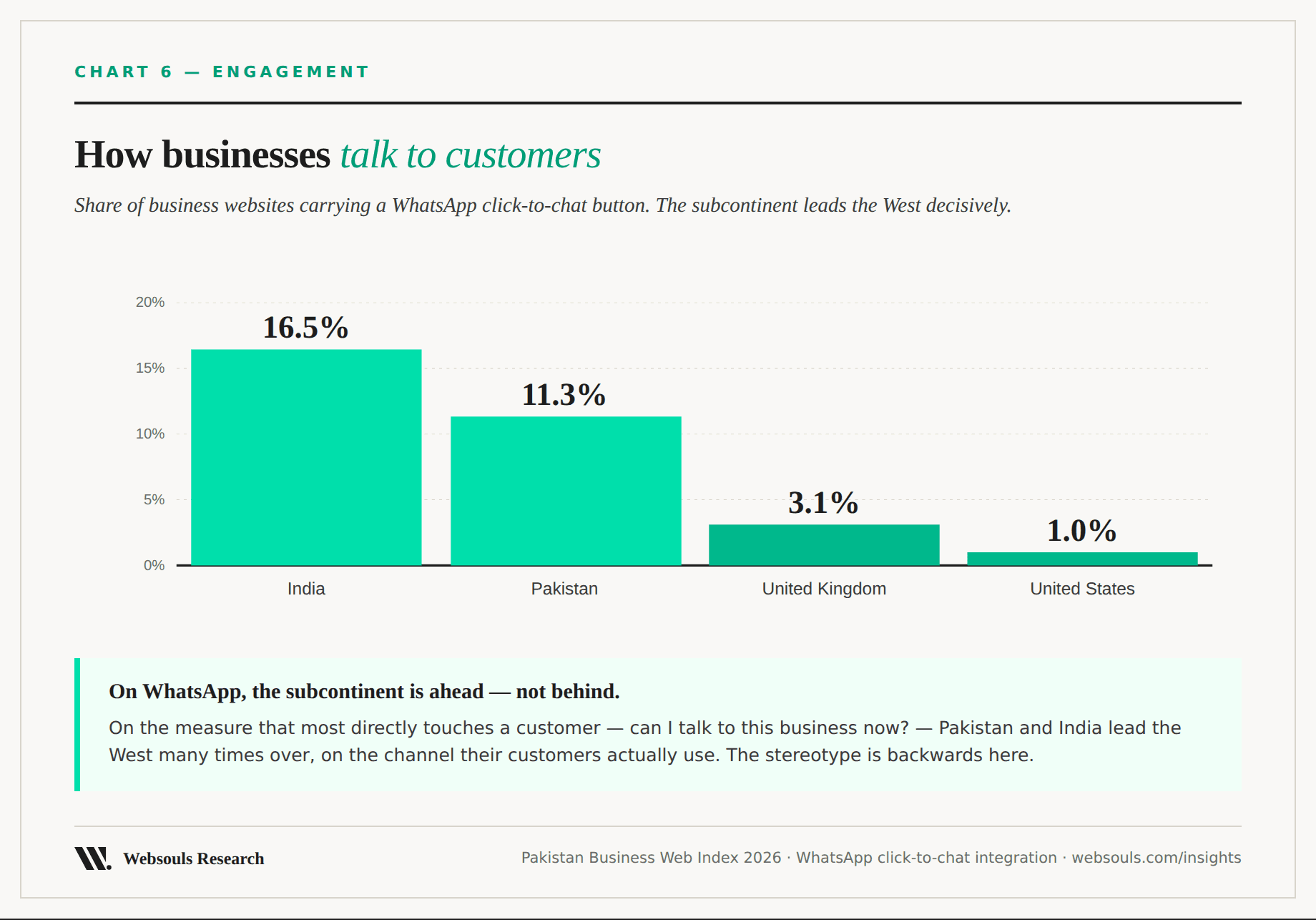
Here the subcontinent leads. Pakistani and Indian businesses talk to customers mainly through WhatsApp — 11.3% of Pakistani sites carry a WhatsApp chat button, and India more still — while Western businesses use a website chat box, at rates near 1–3%. On the measure that matters most to a customer, the subcontinent is ahead, on the channel its customers actually use.
7. The AI reality — loud talk, quiet action
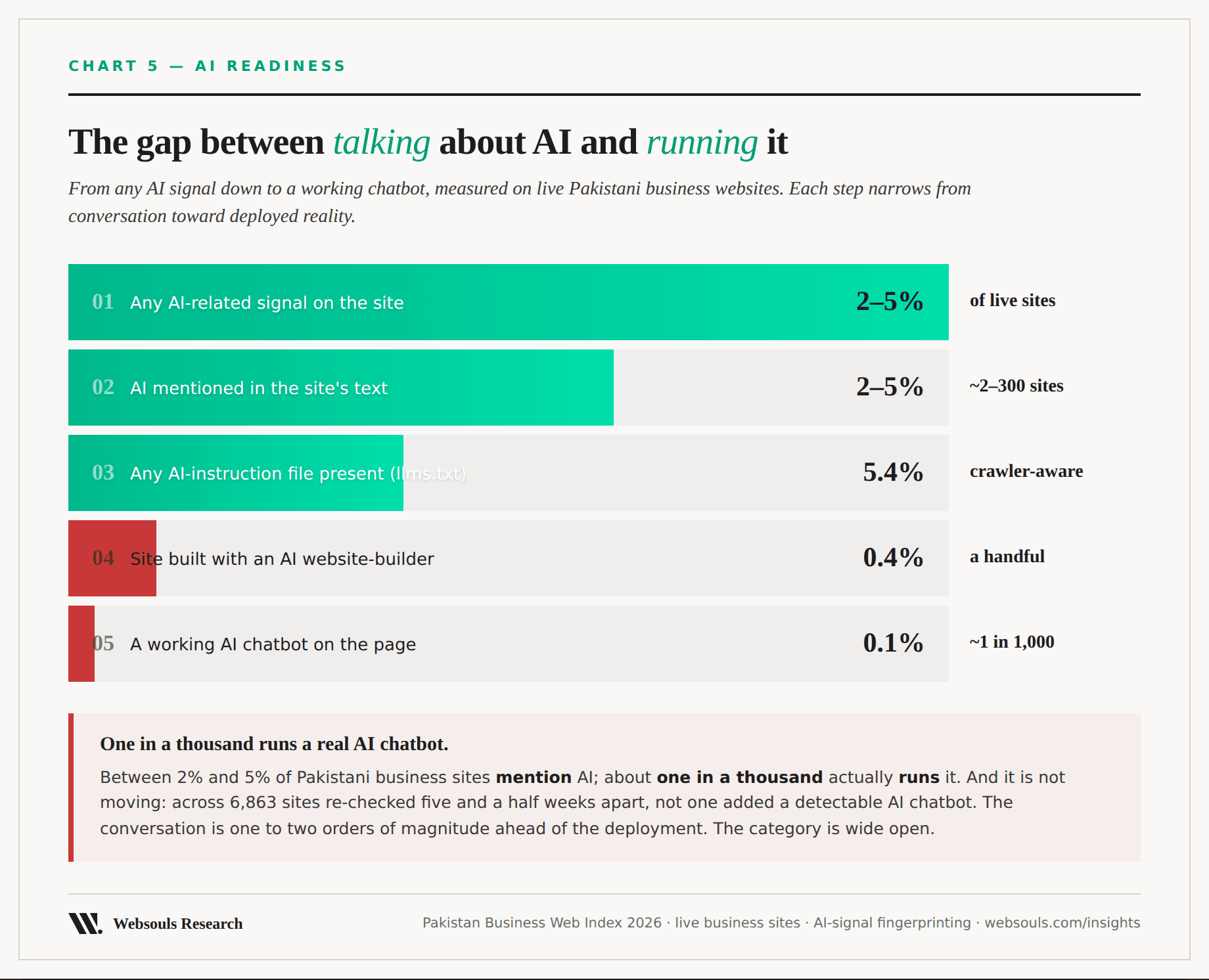
Between 2% and 5% of business websites mention AI somewhere in their text, but only about one in a thousand actually runs an AI tool on the public site. This is as true of Britain and America as of Pakistan. And it is not moving: across 6,863 Pakistani sites re-checked five and a half weeks apart, not one added a detectable AI chatbot. What little AI-readiness exists is mostly an accidental by-product of other software — plugins and hosting defaults — not a deliberate choice. This section measures the public website only; AI used behind the scenes, on WhatsApp or in operations, is invisible here by design.
What follows the Index
This is an index, not a one-off report — the same measurements repeat every year, turning these levels into trends. Alongside it: an interactive dashboard, a companion Hosting Index drawn from 24 years of domain records, free website-health and AI-readiness tools built from this study's own instruments, and a city-by-city series. The full methodology, every limitation, and the robustness annex are in the downloadable report.
What's inside
- Who has a website — nationally, by city, by industry, by business size.
- How Pakistan compares with India, the UK and the US, on identical instruments.
- Technical health, platform mix, WhatsApp use and AI readiness — measured, not assumed.
- A full robustness annex answering every fair challenge, and every limitation quantified.