Key Takeaways
Drupal Hosting is a hosting environment optimized specifically for Drupal websites.
Drupal needs updated PHP support, proper caching, and stronger server resources compared to many basic CMS platforms.
Shared hosting works for small projects, but growing websites usually perform better on VPS, cloud, or managed hosting.
Managed Drupal Hosting handles updates, backups, monitoring, and server maintenance for you.
Cloud hosting has become the preferred option for scalability and uptime in 2026.
Private Cloud and On-premise Hosting are often used by organizations handling sensitive data.
Cheap hosting can create long-term issues with speed, security, and stability.
Hosting affects SEO, user experience, and website performance more than most people expect.
Drupal is great at handling big, complex websites. The only issue is that it has very high standards. Put it on weak hosting, and it starts behaving like a tired employee on a Monday morning.
Slow admin panels, random server errors, failed updates, and pages taking forever to load are usually what Drupal looks like on poor hosting.
That is why Drupal Hosting matters far more than most people realize. In this guide, we will discuss what Drupal hosting actually is, why Drupal needs a different kind of setup, and what to look for when choosing a hosting environment built to handle it properly.
What is Drupal?
Before getting into hosting, it helps to know what Drupal actually is, because a lot of people hear the name and assume it is some kind of hosting service itself. It is not.
Drupal is an open-source CMS used to build and manage websites. A CMS (Content Management System) lets you create pages, organize content, manage users, and extend functionality without building everything from scratch.
Drupal is known for flexibility. It can handle multilingual sites, custom workflows, complex permissions, API integrations, ecommerce systems, and large content structures.
That flexibility is why many organizations still choose Drupal for web projects instead of simple drag-and-drop builders.
Drupal itself is not hosting.
Drupal is the software.
Your hosting is the environment where it runs.
What is Drupal Hosting?
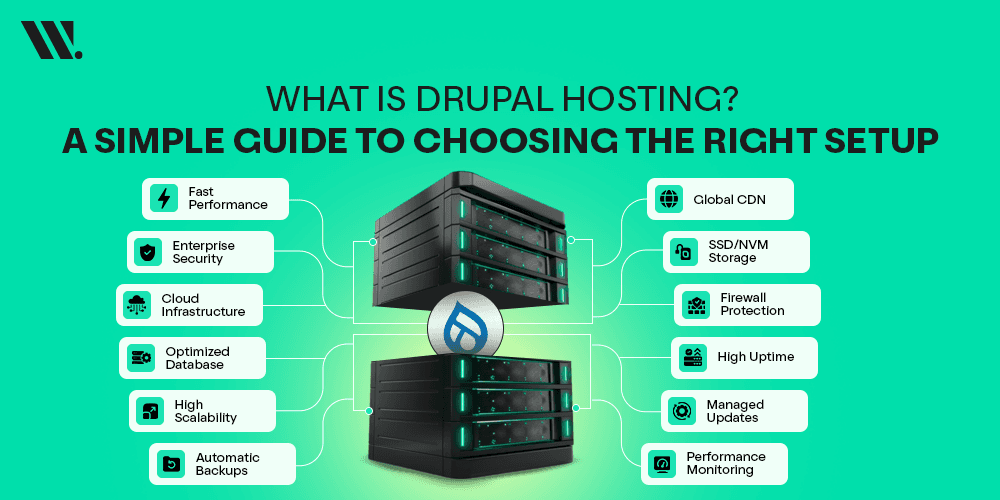
Drupal Hosting is a server environment configured specifically for Drupal websites. The hosting provider supplies the server resources, database support, security setup, caching systems, and software compatibility needed for Drupal to work properly.
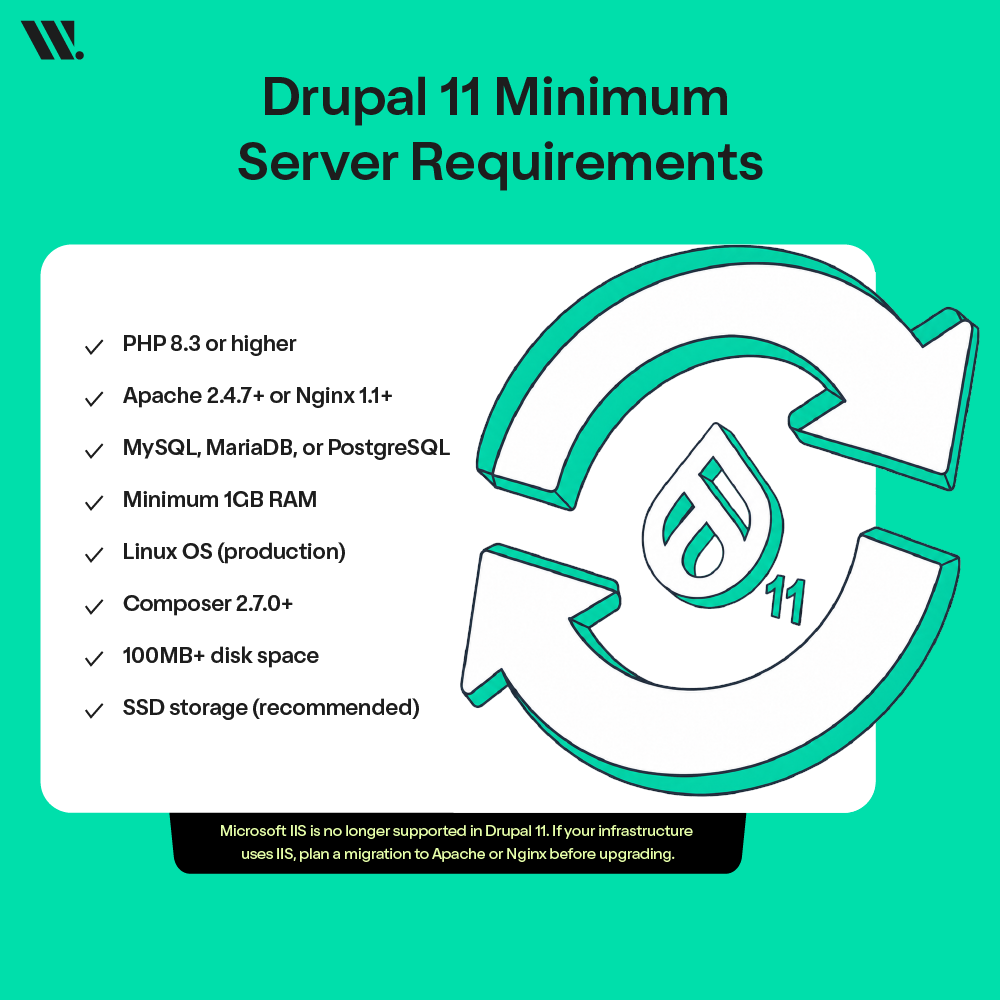
A regular hosting plan may technically support Drupal installations, but that does not mean the environment is optimized for it. According to official Drupal documentation, Drupal 11 requires supported PHP versions, database compatibility, Composer support, and web server configurations such as Apache or Nginx.
Without the proper setup, websites often run into:
Slow page speeds
Failed updates
Caching issues
High memory usage
Downtime during traffic increase
Security vulnerabilities
This is why Drupal web hosting is usually more specialized than standard website hosting.
Looking for the right fit? Explore different web hosting types.
Why Hosting Matters So Much for Drupal
Drupal is capable of handling complex websites, but that complexity also means the server has to work harder in the background. A small brochure-style website may run almost anywhere.
A Drupal website with:
Custom modules
Dynamic content
Heavy traffic
APIs
Multilingual functionality
Ecommerce features
Large databases
will place much higher demands on the server. That is why hosting quality directly affects how Drupal performs. Here is what usually changes when hosting is poorly configured:
Area | What Happens |
|---|---|
Website speed | Pages load slowly |
Admin dashboard | Backend becomes sluggish |
Updates | Modules fail during upgrades |
Traffic spikes | Website crashes or times out |
Security | Vulnerabilities increase |
SEO | Rankings can drop due to poor performance |
Over the years, one thing has become obvious very quickly: most Drupal performance problems are actually hosting problems first.
Types of Drupal Hosting
Different Drupal websites need different hosting environments. A university portal and a small business website will not need the same infrastructure. Here are the main hosting types used for Drupal in 2026.
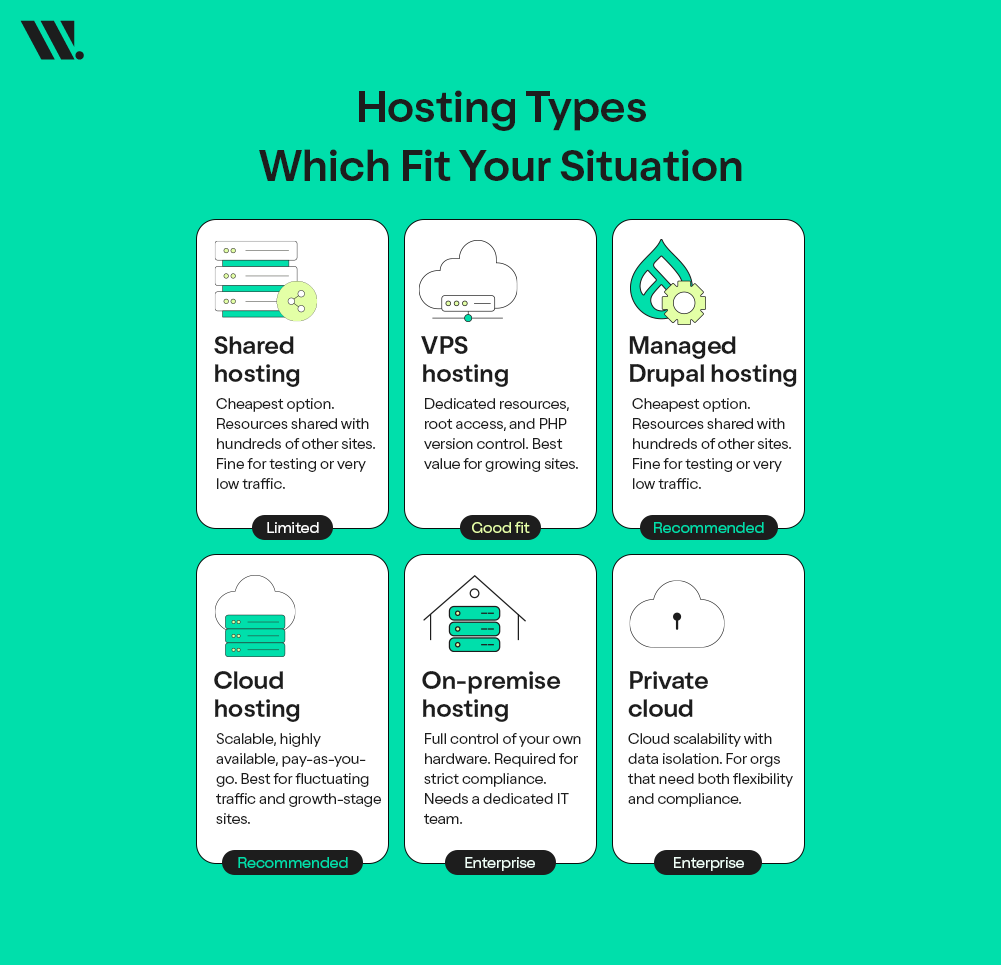
Shared Hosting
Shared hosting places multiple websites on the same server. It is usually the cheapest option and often the first starting point for beginners. For small Drupal projects with low traffic, shared hosting can work temporarily. But resource limitations become noticeable as the website grows. The biggest issue with cheap shared hosting is inconsistency. One busy website on the same server can affect every other website sharing resources. In many cases, Drupal websites outgrow shared hosting quickly.
Best for:
Test websites
Learning Drupal
Very small websites
Limitations:
Slower performance
Lower memory limits
Limited customization
Weaker scalability
If the website matters to your business, shared hosting should usually be treated as a starting point, not a long-term setup.
VPS Hosting
A VPS, or Virtual Private Server, gives your website dedicated resources inside a virtual environment. This setup offers more control, stronger performance, and better stability compared to shared hosting. For many businesses, VPS hosting is the point where Drupal starts performing much more smoothly.
It also gives developers greater control over:
PHP settings
Caching systems
Server configurations
Security layers
Best for:
Growing business websites
Medium traffic platforms
Custom Drupal environments
Benefits:
Dedicated resources
Stronger performance
Better scalability
More server control
For many Drupal projects, VPS hosting is often the best balance between cost and performance.
Managed Drupal Hosting
Managed Drupal hosting is where the hosting provider handles the server setup, security patching, updates, backups, performance tuning, and technical maintenance on your behalf. You focus on your website. They handle the plumbing.
With managed hosting, the provider handles:
Updates
Monitoring
Backups
Security patching
Performance tuning
Server maintenance
This reduces technical overhead significantly. A good Managed hosting setup is usually optimized for Drupal from day one, including caching layers, database tuning, and security monitoring. For businesses without an internal DevOps team, managed hosting often saves both time and operational stress.
Best for:
Business websites
Ecommerce projects
Enterprise CMS platforms
Teams without dedicated server administrators
Main advantage:
Less time spent managing infrastructure.
Cloud Hosting
Cloud hosting uses a network of servers instead of relying on one physical machine. This allows websites to scale resources more easily when traffic increases. It has become one of the most common choices for Drupal websites because uptime and scalability are much stronger compared to traditional setups. Large traffic spikes are easier to manage, and server failures become less disruptive because workloads can shift between systems.
Best for:
High-traffic websites
Enterprise projects
Growing platforms
Scalable applications
Benefits:
Flexible resources
Stronger uptime
Scalability
Better traffic handling
Cloud hosting also works very well for modern Drupal architectures, including headless CMS setups.
Private Cloud Hosting
Private Cloud hosting provides cloud-style infrastructure dedicated to a single organization. Unlike public cloud environments, resources are not shared across unrelated companies.
Organizations often choose Private Cloud environments for:
Compliance requirements
Data privacy
Internal security policies
Infrastructure customization
Best for:
Government organizations
Financial systems
Healthcare platforms
Enterprise applications
Main advantage:
Higher control over infrastructure and data environments.
On-premise Hosting
On-premise Hosting means the organization manages physical servers internally instead of renting infrastructure externally. This setup offers complete control but also creates greater operational responsibility.
The organization handles:
Hardware
Security
Maintenance
Redundancy
Updates
Network infrastructure
Large enterprises and regulated industries sometimes prefer this model for security and compliance reasons.
Best for:
Highly regulated industries
Organizations with internal IT teams
Sensitive infrastructure environments
Main challenge:
Higher maintenance and operational costs.
What To Look For in a Drupal Hosting Provider
Once you know which hosting type suits your situation, the next step is evaluating specific providers. There are a few things worth checking before signing up. The server needs to meet Drupal's technical requirements. PHP 8.3 or higher, Apache 2.4.7+ or Nginx 1.1+, and a supported database version; these are non-negotiable for Drupal 11. Some shared hosts still run older PHP versions by default, so always check. You can verify the full official requirements on drupal.org.
Beyond the basics, look for:
SSD or NVMe storage - traditional hard drives are significantly slower and affect page load times directly
Caching support - Varnish, Redis, or Memcached makes a big difference in Drupal's database-heavy architecture
Staging environments - you want to test changes before pushing them live
Automated backups with easy restores - not just backups that sit there, but ones you can actually recover from quickly
SSL included - it is standard now, but still worth confirming
PHP version control - the ability to switch PHP versions from your dashboard without opening a support ticket
24/7 support with Drupal knowledge - general server support is fine, but support staff who know Drupal-specific issues save you hours
Drupal Hosting vs Regular Hosting
A lot of people assume all hosting is basically the same. That usually changes after running Drupal on an underpowered server. Here is the difference between standard hosting and Drupal-focused hosting.
Regular Hosting | Drupal Hosting |
|---|---|
General-purpose setup | Optimized for Drupal |
Basic resource allocation | Better performance tuning |
Limited Drupal support | Drupal-focused environments |
Minimal caching | Advanced caching systems |
Lower scalability | Better traffic handling |
Generic security setup | Drupal-focused optimization |
Drupal can technically run on many hosting plans. The experience becomes very different once traffic, modules, APIs, and larger databases enter the picture.
Want Cheap Drupal Hosting? Think Again
Budget matters. Every business watches costs. But with Drupal, ultra-cheap hosting often creates larger expenses later through downtime, migration problems, slow performance, and support limitations.
Many low-cost hosting providers:
Overload servers
Limit resources aggressively
Delay updates
Use outdated configurations
That combination usually affects:
SEO rankings
Website speed
Customer experience
Conversion rates
Platform stability
For very small learning projects, cheap hosting can still work. For production websites, investing in stable hosting usually saves far more time and money long term.
Drupal Hosting in 2026 - What Has Changed
Drupal hosting has changed significantly over the past few years. Modern Drupal websites now rely more heavily on:
Cloud infrastructure
Containerized environments
CDN integrations
API-driven architecture
Headless CMS setups
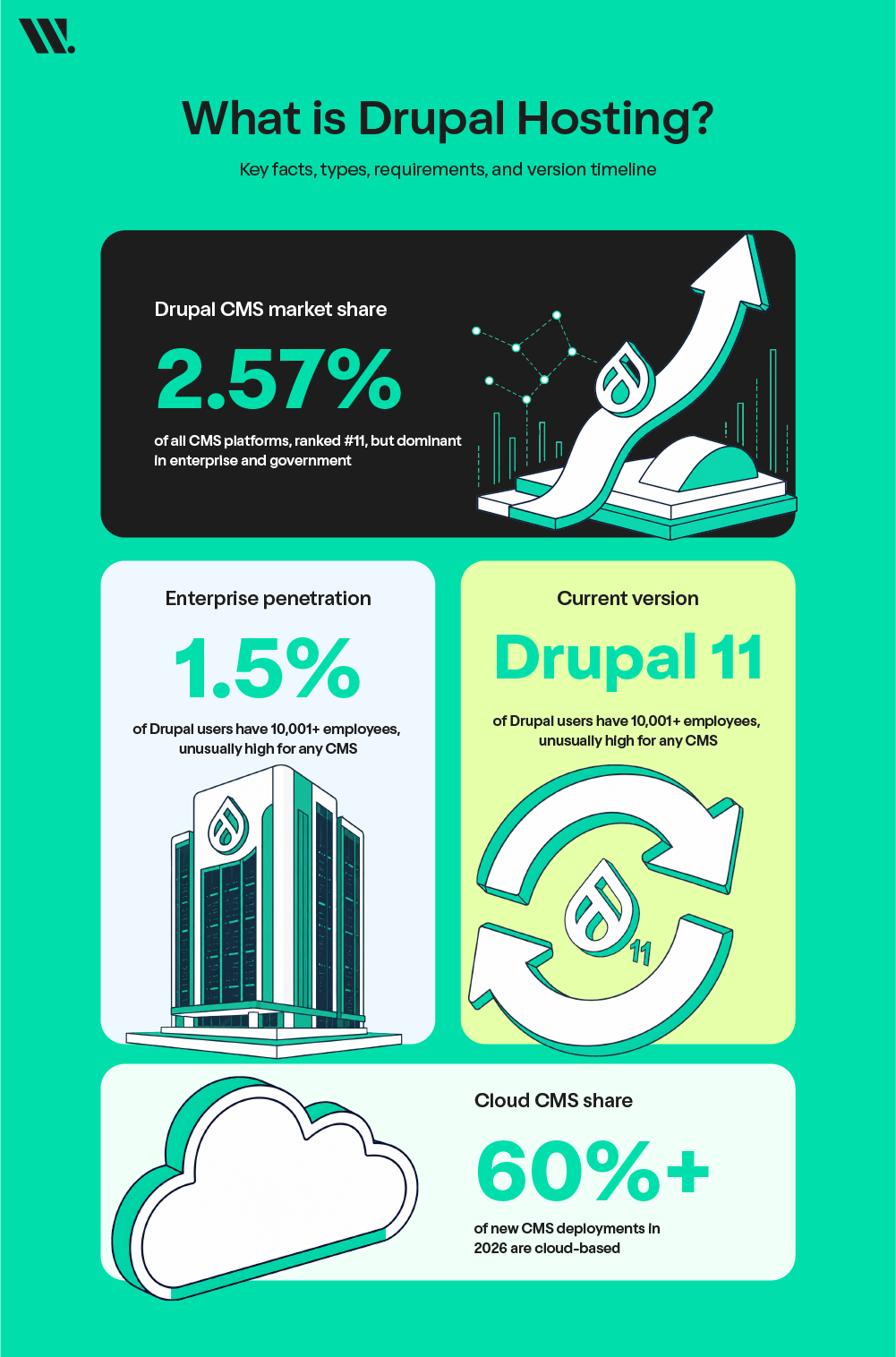
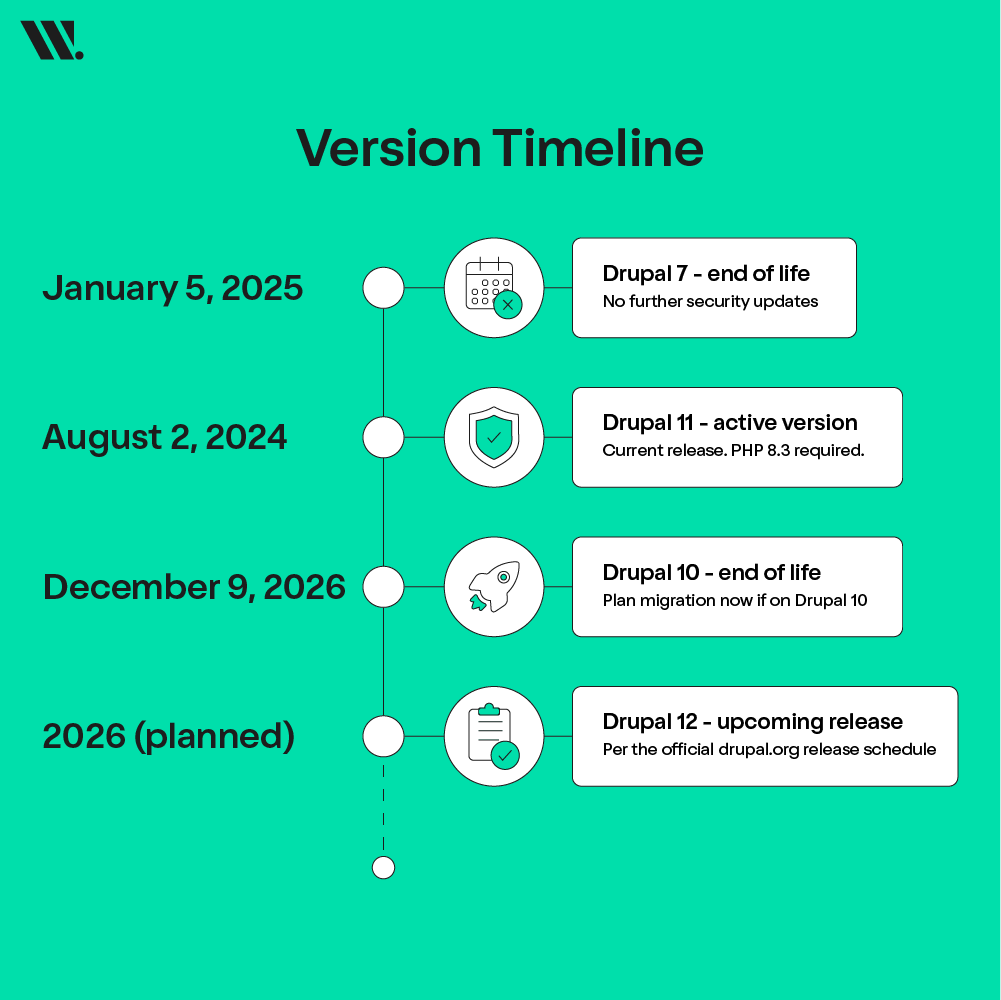
At the same time, Drupal itself continues growing. Drupal 11 remains the active version in 2026, while Drupal 10 reaches end of life in December 2026 according to official Drupal release schedules. That means hosting compatibility and update planning matter more than ever for long-term website stability.
Final Thoughts
Drupal remains one of the strongest CMS platforms for websites that need flexibility, scalability, and long-term growth. The hosting behind that website plays a major role in how successful the project becomes over time.
A strong hosting environment helps with:
Speed
Uptime
Security
Scalability
Smoother updates
Better user experience
A weak hosting setup usually creates the opposite experience. If you are planning a Drupal website and trying to decide between shared hosting, VPS, managed hosting, cloud infrastructure, private cloud, or on-premises hosting, the best choice depends on how your website will actually grow over time, not just what looks cheapest today.
At Websouls, we work with businesses and organizations at all stages of the Drupal journey, from picking the right hosting environment to managing migrations, performance issues, and ongoing support. If you are trying to figure out the best setup for your Drupal website, we are happy to talk through it with you. No pressure, just guidance.
FAQs for Drupal Hosting
Does Drupal itself provide hosting?
No. Drupal is software you install on a server. You choose a separate hosting provider. Drupal.org only provides the CMS, not hosting services.
Is Drupal hosting different from WordPress hosting?
Yes. Both use similar tech, but Drupal is heavier on server resources, so it performs better on optimized or VPS hosting than typical WordPress-tuned shared plans.
Can I move my Drupal website from one host to another?
Yes. It involves moving files, databases, and configs, then updating credentials and testing before switching domains. Many managed hosts offer migration tools.
What is the difference between Drupal CMS and Drupal core?
Drupal core is the base system built for developers. Drupal CMS (based on Drupal 11) comes pre-configured with ready features for easier setup and use.
Does Drupal 11 work on Windows hosting?
Not for production. Drupal 11 is designed for Linux with Apache or Nginx. Windows is only supported for local development environments.
How much RAM does a Drupal website need?
At least 1GB RAM for basic functionality. Most real sites run better with 2-4GB+, especially when using caching tools or handling traffic.
What is Drupal 12, and when will it be released?
Drupal 12 is planned for 2026 as the next major version. Drupal 10 reaches end of life in December 2026, so upgrades will become important.
What is a staging environment, and do I need one?
A staging site is a test copy of your live site used for safe updates. It is essential for Drupal sites to avoid breaking production during changes.
What is headless Drupal, and does it change hosting needs?
Headless Drupal uses APIs for content and a separate frontend like React. It requires more flexible hosting, often cloud-based, to handle API traffic.
Can I use Drupal with a CDN?
Yes. A CDN speeds up Drupal by serving static assets from global servers. Tools like Cloudflare or Fastly integrate easily and reduce server load.